
Table of Contents
Introduction
If you’ve ever stood behind a shop counter watching a scale refuse to show the right number, you already know how much a weighing scale motherboard actually matters. It’s not a glamorous topic, nobody frames a circuit board and hangs it on the wall, but this one component is the real brain behind every weighing system you’ve ever used, from the small kitchen scale to the big industrial platform at a factory warehouse. In this guide we’ll walk through what it is, the different types available, rough pricing, what’s inside a PCB kit, and how to actually buy the right one without getting cheated.
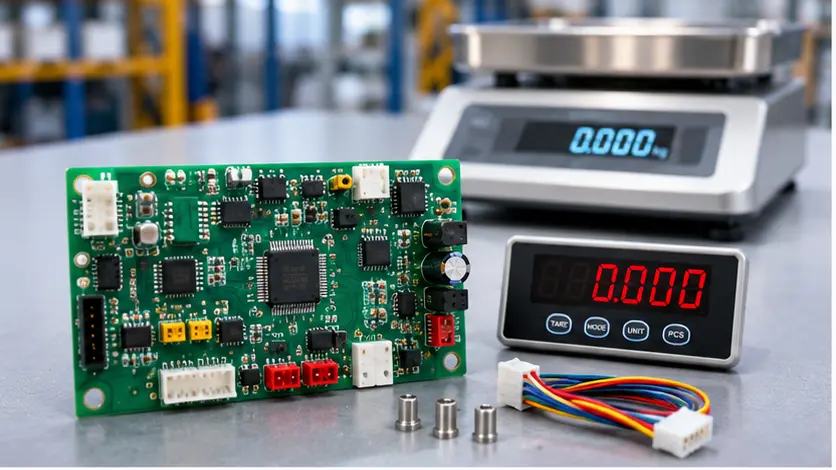
What is a Weighing Scale Motherboard?
Let’s start simple. This board is the circuit that reads the tiny electrical signal coming from your load cell and turns it into the number you see on the display. No board, no number. The scale, without it, is just a dead piece of metal sitting there.
People often confuse the term with “PCB,” asking suppliers for a PCB in one breath and a motherboard in the next, thinking they’re different things. Mostly, they’re not. PCB is short for Printed Circuit Board, the physical board itself. Motherboard is the more functional word used for the main controlling board of the whole scale. In everyday supplier conversation, both terms point to the same product, an electronic weighing scale motherboard that does the amplifying, filtering, and calculating work behind every reading.
Here’s roughly how it works, no technical degree required. You place the item on the platform. The load cell bends, ever so slightly, and sends out a weak electrical signal. On its own that signal means nothing. The board amplifies it, filters the noise, converts it from analog to digital, and runs the maths. Milliseconds later, the display shows your number. Honestly, it’s a small miracle that happens dozens of times a day in every shop without anyone noticing.Types of Weighing Scale Motherboards
Digital vs Analog
Digital weighing scale motherboard units process the signal right at the load cell level and then send a clean digital output onward. They’re more accurate, more stable over time, but they cost more too. Analog boards, on the other hand, take the raw analog signal and do all the conversion work themselves on the main board, cheaper upfront, though a little more prone to drift, especially in older or lower-quality kits.
For small retail counters and basic kitchen setups, analog usually does the job fine. For industrial platforms, pharma weighing, or truck scales, go digital, don’t try to save money here, it rarely ends well.Platform/Multi-cell vs Tabletop/Single-cell
Platform scale boards are built for heavier capacity, often from 100kg right up to several tons, and usually support four or more load cells working together. Tabletop boards are lighter duty, made for retail counters, jewellery scales, and small kitchen weighing, typically running off a single cell.
Mixing these up is more common than you’d think. A tabletop board simply can’t handle the combined signal load from a four-cell platform setup, readings go wrong, or the board just gives up and burns out. Newer wireless and Bluetooth-enabled boards are also showing up now, mostly for warehouses wanting digital records without manual entry, though not every business really needs one yet.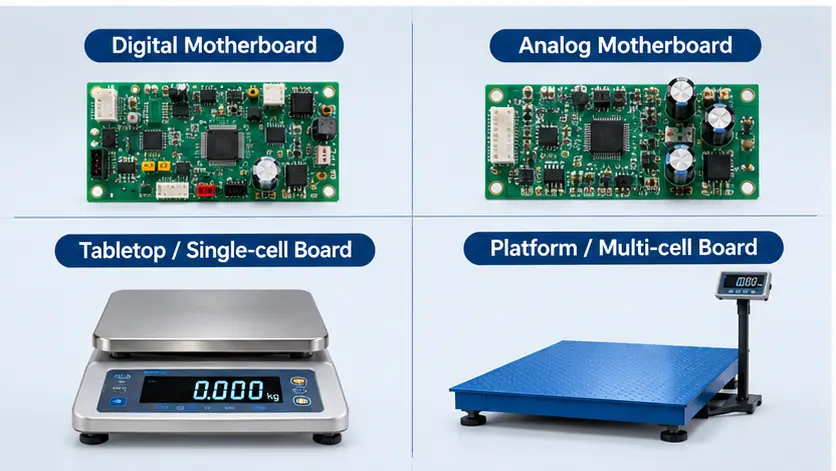
Weighing Scale Motherboard Price in India
Price Range by Type and Capacity
A basic motherboard weighing scale PCB for a small tabletop unit generally falls somewhere between ₹400 and ₹1,200. If you’re asking about a 20 kg weight machine motherboard price or a 30 kg weight machine motherboard price specifically, expect it to sit toward the lower end of that range, since these are low-capacity, single-cell boards with simpler circuitry.
Step up to a 100 kg weight machine motherboard price, and you’re usually looking at somewhere between ₹1,000 and ₹2,500, depending on whether it’s single or multi-cell. A 200 kg weight machine motherboard price can climb further, often ₹1,500 to ₹5,000+, since these boards are generally built for platform scales with multiple load cells summing together. Industrial-grade, high-precision boards used in pharma or lab settings can cross ₹8,000–₹10,000 without much trouble. These are ballpark figures only, prices shift with raw material costs and supplier margins, so always confirm current rates before placing an order.Why Two "Same-Looking" Boards Cost Differently
This part trips up even experienced buyers. Two PCBs can look nearly identical from the outside, same green board, similar layout, yet the actual components soldered onto them tell a completely different story. Original ADC chips versus duplicate ones. Branded microcontrollers versus unnamed clones. Factory-calibrated accuracy versus “figure it out yourself at install.”
A supplier once told me, half-joking, “customer, board dikhta same hai, par ander ka IC alag duniya hai.” He wasn’t wrong. Add to that the hidden costs, calibration charges, warranty length, and compatibility with your existing display, and that “cheap deal” can quietly end up costing more than the premium option. If you’re sourcing in bulk, it’s worth checking with an established weighing scale motherboard manufacturer rather than an unverified reseller, just to be sure what you’re actually paying for.Weighing Scale PCB Kit What's Inside
A PCB kit usually isn’t just the bare board sitting alone in a box. It’s a small package. Typically you’ll find the main board, a display unit with LED or LCD readout (bundled sometimes, sold separately other times), connecting wires or ribbon cables, mounting screws, and occasionally a basic calibration manual tucked in.
There are generally two routes here. DIY kits are cheaper but assume you, or your technician, can handle the wiring and calibration without hand-holding. Ready-fit kits cost a little more but are essentially plug-and-play, built to match your exact scale model. If you’re not particularly technical, honestly, just spend the extra few hundred rupees on a ready-fit kit, a weighing scale motherboard with display already matched to your unit saves a lot of back-and-forth later.How to Choose the Right Motherboard (Buying Guide)
Match Capacity First, Ask Questions Second
Before anything else, check your scale’s maximum capacity and the number of load cells it runs. A board rated for 100kg simply won’t survive being pushed on a 500kg platform setup, this isn’t negotiable. Once that’s sorted, ask your supplier directly: is this compatible with my scale’s brand and model, what’s the warranty period, is calibration included, and is it an original component or a compatible clone. A supplier confident in their product won’t dodge these questions.
Red Flags of a Cheap or Duplicate Board
Common Problems with Weighing Scale Motherboards
Final Thoughts
At the end of the day, buying a weighing scale motherboard isn’t an exciting purchase. Nobody gets thrilled picking a circuit board. But get it wrong, and your whole counter operation stalls, right in front of customers who are already waiting.
So take the extra few minutes. Check your scale’s capacity, ask your supplier the right questions, and don’t just chase the cheapest price on the page. For genuine components, proper calibration support, and a team that actually answers compatibility questions honestly, you can check out Gjimpex, built for exactly this kind of sourcing, whether you need a single board or bulk supply for your production line.